Vietnamese Language: A Complete Guide for Travelers
Vietnam is one of Southeast Asia’s most vibrant destinations, attracting millions of travelers each year. Beyond its breathtaking landscapes and delicious cuisine, one of the most fascinating aspects of Vietnam is its language—Vietnamese (Tiếng Việt). For tourists, expats, and language enthusiasts, learning about Vietnamese is not only practical but also a gateway to deeper cultural understanding.
This article provides a complete overview of the Vietnamese language, its history, features, dialects, and tips—perfect for anyone searching for "Vietnam language" before booking flights.
 Vietnamese Calligraphy
What is the Official Vietnamese language?
The official Vietnamese language is Vietnamese (Tiếng Việt), a tonal Austroasiatic language whose historical development spans over 2,000 years. Unlike many Asian languages, it uses the Latin alphabet, making it surprisingly accessible for English speakers.
- Official Language: Vietnamese is the official language of Vietnam.
- Speakers: Over 86 million native speakers in Vietnam and about 4 million overseas Vietnamese communities worldwide.
- Language Family: Belongs to the Austroasiatic family, specifically the Vietic branch.
- Writing System: The Quốc Ngữ writing system was developed and systematized in the 17th century by European missionaries, most notably Alexandre de Rhodes, and later standardized and popularized by Vietnamese scholars.
Vietnamese evolved from ancient Viet-Muong dialects, influenced by Chinese occupation (which introduced Sino-Vietnamese vocabulary) and French colonialism (shaping the modern script, Quốc ngữ, in the 17th century). Today, it's the mother tongue for 85-90% of Vietnam's 100 million population, with standardized pronunciation based on the Hanoi dialect.
Historical Development
Early Periods: Initially influenced by Classical Chinese (9th–13th century).
Chữ Nôm: A logographic script adapted from Chinese characters (13th–17th century).
Romanization: Modern Vietnamese script was introduced by Portuguese missionaries and later standardized by French colonial authorities.
Key Features of Vietnamese
Tonal Language: Vietnamese has six tones, although in Southern dialects some tones are pronounced similarly and may sound merged to learners.
Alphabet: Uses Latin letters with diacritics for tones and vowel distinctions.
Loanwords: Influenced by Chinese, French, and English.
Fun fact
Vietnamese has six tones: level, rising, falling, dipping, creaky rising, and heavy falling, each marked by specific diacritics. A wrong tone can hilariously change "má" (mother) to "mả" (tomb)! This tonal system is key to the Vietnamese language, adding melody to everyday speech.
Why This Matters for Travelers: A mispronounced tone can lead to confusion or unintended humor. For instance, bánh (cake) versus bành (to spread). Don’t be discouraged; context and a polite effort go a very long way. Most Vietnamese people are delighted by any attempt to speak their language and will kindly help you.
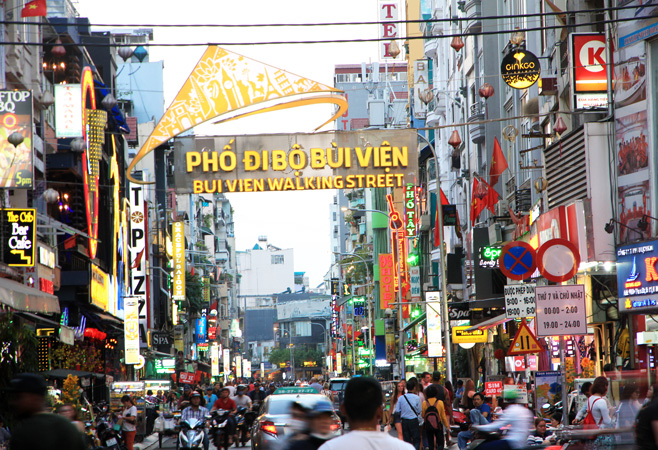 Vietnamese signboards are used alongside English in tourist areas with large numbers of foreign visitors
Vietnamese Dialects: Navigating Regional Variations
Vietnam's linguistic diversity mirrors its geography. While standard Vietnamese (based on Northern Hanoi dialect) dominates media, education, and urban areas, three main Vietnamese language dialects exist:
Northern (Hanoi): Considered the standard.
Crisp consonants (e.g., "tr" like "ch"), used in official settings. Ideal for learners targeting formality.
Central (Hue/Da Nang): Distinct pronunciation.
Heavier tones and noticeable consonant shifts (e.g., “trong” may sound closer to “chông”). Heavier tones, dropped final consonants (e.g., "trong" becomes "chông"). Locals here speak with poetic flair—think royal heritage.
Southern (Ho Chi Minh City/Mekong Delta): Softer tones, widely spoken by locals.
Softer, with merged tones and "d/gi/r" all sounding like "y" (e.g., "rất ngon" as "yất ngon"). Most tourist-friendly, as Southerners adapt to foreigners.
Traveler's Tip: For visitors, learning Southern dialect phrases is practical if you're spending time in Ho Chi Minh City and the Mekong Delta, while Northern phrases are key for Hanoi and Ha Long Bay. Don't worry about mixing them; your effort is what counts.
Why Learn the Vietnamese Language Before Visiting?
Ease of Travel: Basic phrases help with taxis, restaurants, and markets. In a country where English proficiency is common in major cities and tourist areas, but remains limited in rural regions and among older generations, basic Vietnamese language skills transform trips. English signs abound in cities, but rural areas like Sapa or Ninh Binh rely on Vietnamese.
Cultural Connection: Locals appreciate foreigners making an effort.
Safety & Convenience: Understanding signs and menus avoids confusion.
Business Opportunities: Vietnam is a growing economy; language skills are valuable.
 Learning a few basic Vietnamese phrases will help visitors communicate more easily and better explore Vietnamese culture.
Essential Vietnamese Phrases for Vietnam Travel
Learning basic Vietnamese phrases demonstrates respect for local culture and significantly enhances travel experiences. Practice these for your Vietnam language toolkit:
Greetings and Politeness
Hello: Xin chào (sin chow)
Thank you: Cảm ơn (kahm uhn)
Yes/No: Có (koh)/Không (kohm)
Excuse me/Sorry: Xin lỗi (sin loy)
Goodbye: Tạm biệt (tahm bee-yet) or Chào (chow) - informal
Directions and Transport
Where is...? : ...ở đâu? (oh dow?)
Left/Right/Straight: Trái/Phải/Thẳng (chrai/fai/tang)
How much?: Bao nhiêu tiền? (bow nyew tee-en?)
I don't understand: Tôi không hiểu (toy khome hee-ew)
Do you speak English?: Bạn có nói tiếng Anh không? (ban gaw noy teeng anh khome?)
Food and Shopping
Delicious!: Ngon quá! (ngawn kwa)
Water/Beer: Nước/Một bia (noo-uk/mot bee-uh)
Too expensive: Đắt quá! (dat kwa) → Haggle to "Giảm giá!" (jam zai, cheaper!)
The check, please: Tính tiền (teen tee-en)
I'm a vegetarian: Tôi ăn chay (toy an chai)
Where is the toilet: Nhà vệ sinh ở đâu? (nyah veh sin uh dow?)
Emergencies
Help!: Cứu tôi! (kyoo toy)
Doctor/Hospital: Bác sĩ/Bệnh viện (bahk see/ben vien)
Understanding personal pronouns is crucial in Vietnamese, as they reflect age, gender, and social relationships. The language uses different pronouns depending on the speaker's relationship to the listener, making it more complex than English but deeply respectful of social hierarchies.
Common Mistakes and Cultural Etiquette
Avoid these Vietnamese language pitfalls:
Ignoring tones: "Bò" (beef) vs. "bố" (dad)—awkward!
Over-formality: Choosing the correct personal pronoun is important, as Vietnamese pronouns reflect age, relationship, and social context.
Pronunciation: "Ph" is "f," "kh" like Scottish "loch."
Etiquette: Using both hands when giving or receiving items is considered polite, especially in formal or respectful situations; "cảm ơn" profusely. Vietnamese value humility—phrases build rapport faster than cash.
Tips for Learning Vietnamese Before Traveling
Learn tones early and practice listening
Focus on practical travel phrases
Use language apps and audio tools
Practice with native speakers if possible
Short-term visitors don’t need fluency—basic conversational Vietnamese goes a long way.
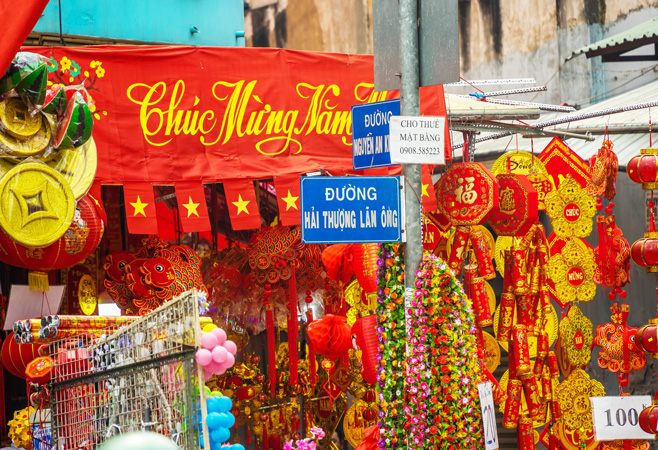 Learning Vietnamese becomes easier with Vietnamese street signs
Frequently Asked Questions
What language is spoken in Vietnam?
The official language of Vietnam is Vietnamese (Tiếng Việt), spoken by the majority of the population.
Is Vietnamese hard for foreigners to learn?
Vietnamese can be challenging due to its tonal system, but its simple grammar makes basic communication achievable with practice.
Should I learn the Northern or Southern dialect before traveling?
It depends on your itinerary. If you're spending most of your time in Hanoi, Ha Long Bay, or Sapa, focus on Northern pronunciation resources. If your trip centers on Ho Chi Minh City, the Mekong Delta, or coastal towns like Nha Trang, Southern resources will be more directly applicable. Either way, all Vietnamese speakers will understand the standard form.
Is English widely spoken in Vietnam?
English is common in tourist areas and big cities, but less common in rural regions.
What writing system does Vietnamese use?
Vietnamese uses the Latin-based Quốc Ngữ alphabet with diacritical marks.
Are there different Vietnamese dialects?
Yes, the main dialects are Northern, Central, and Southern Vietnamese.
Do People in Vietnam Speak English?
English is increasingly spoken in Vietnam, especially in:
Major cities (Hanoi, Ho Chi Minh City, Da Nang)
Tourist areas
Hotels, restaurants, and airports
However, outside urban centers, English proficiency may be limited. Understanding basic Vietnamese language expressions can help travelers navigate rural areas more comfortably.
What are the main dialects of Vietnamese?
Northern, Central, and Southern, with Northern being the standard.
How can I practice Vietnamese before my trip?
Use apps like Duolingo, watch Vietnamese media, or join language exchange groups.
Is the Vietnamese alphabet similar to English?
Yes, it's Latin-based with diacritics for tones and sounds.
What's the Vietnamese alphabet like?
Latin-based (29 letters) with diacritics for tones—easier than Thai or Chinese.
Can I visit Vietnam without knowing the language?
Absolutely, with apps and tours, but the basics enhance safety and joy.
How do I say "thank you" in Vietnamese?
"Cảm ơn" (kahm uhn)—use it everywhere!
Can I get by with just English in Vietnam?
In major cities like Hanoi, Ho Chi Minh City, and popular tourist destinations like Da Nang and Hoi An, many people working in tourism, hotels, and restaurants speak functional English. However, English proficiency drops significantly in rural areas, local markets, and among older generations.
Related Articles
- Vietnamese Zodiac Years: 12 Animals, Years & Personality Traits
- Cham Island Travel Guide: Things to Do, Tours & Travel Tips
- Vietnam Emergency Number Guide: Who to Call in an Emergency
- Vietnam Golden Visa Guide: Everything You Need to Know
- What Is the Vietnamese Hat? History, Culture & Meaning
- Best Vietnam eSIM for Tourists: Plans, Prices & Setup
- Vietnam Sleeper Bus Guide: Experience, Comfort & Safety
- Vietnam Visa for Children: Rules, Requirements & Family Guide
- Vietnam Nightlife Guide 2026: Best Cities, Bars & Night Experiences
- Vietnam Visa for Cruise Travelers: Rules, Ports & Application Guide

HOW CAN WE HELP?
 NEED HELP 24/7
 United States
+1 949 346 9868
United States
+1 949 346 9868
 United Kingdom
+44 0330 822 7696
United Kingdom
+44 0330 822 7696
 Singapore
+65 6485 3630
Singapore
+65 6485 3630
 Viber
+65 8174 8526
Viber
+65 8174 8526

APPLY WITH CONFIDENCE